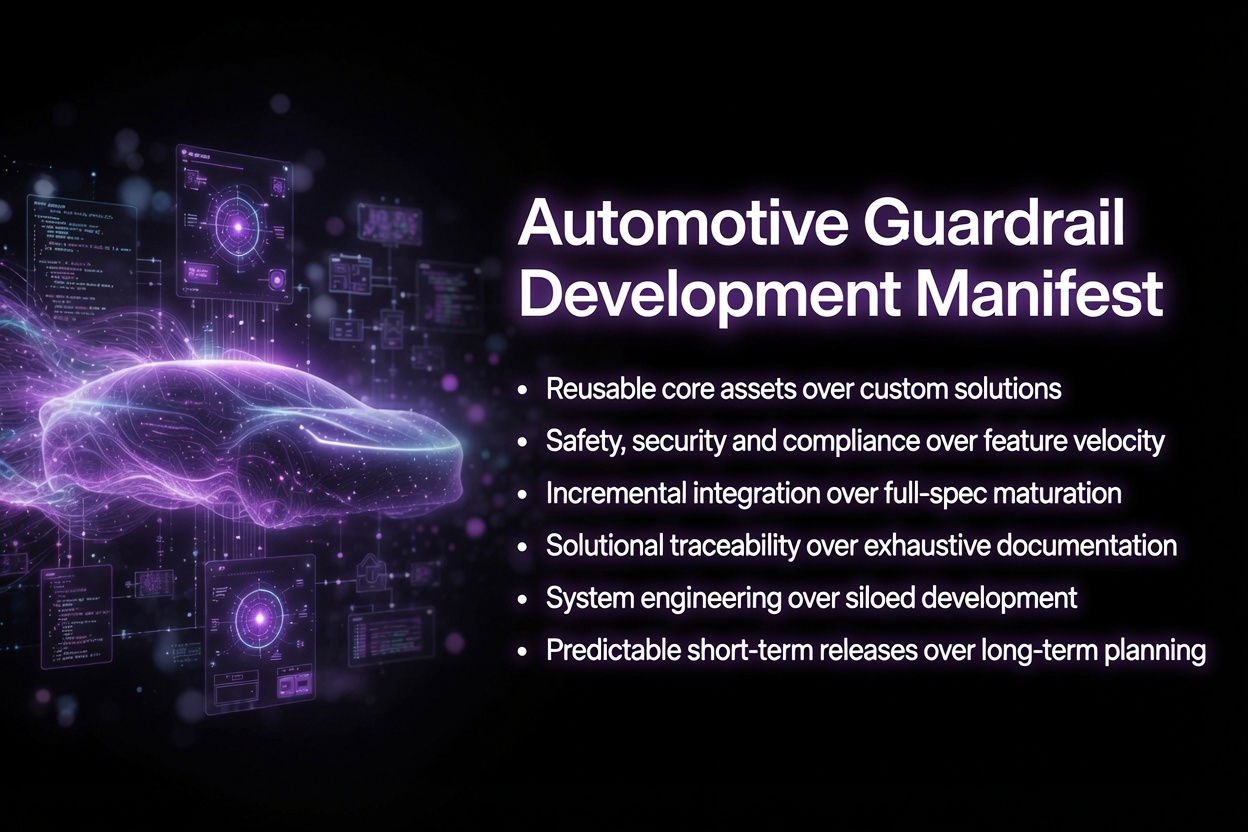
Automotive Guardrail Development Manifest
A new development paradigm for software-defined vehicles — combining the speed and creativity of agile with the rigor, safety, and long-term thinking required in automotive engineering.
Why not just use Agile?
Pure Agile works extremely well in pure software environments. However, in automotive it quickly reaches its limits. Vehicles are safety-critical systems with complex hardware-software integration, strict regulatory requirements, long validation cycles, and global multi-tier supply chains.
Naively applying Agile in this domain often leads to insufficient traceability, unstable platforms, safety risks, and ultimately slower time-to-market once the hidden costs of rework and certification surface.
Smart China Speed — done right
Chinese OEMs and suppliers have shown impressive development speed in recent years. The Automotive Guardrail Development approach enables Western companies (and responsible global players) to achieve similar velocity — but with superior quality, safety, and long-term platform sustainability.
It is not “Agile with extra process”. It is a new synthesis that keeps the wild spirit of agile innovation while installing intelligent guardrails where they matter most.
Core Values
- Reusable core assets over custom solutions
- Safety, security and compliance over feature velocity
- Incremental integration over full-spec maturation
- Solutional traceability over exhaustive documentation
- System engineering over siloed development
- Predictable short-term releases over long-term planning
Principles
- Lead with reusable core assets. We prioritize building modular, loosely coupled, out-of-context enablers and platforms bottom-up. These timeless core assets are designed for maximum reuse across vehicle generations and form the stable foundation of all development — including monitored and guarded AI/ML components. On legacy platforms, evolve toward this state incrementally by encapsulating existing assets behind defined claims — avoiding big-bang rewrites.
- Safety, security, and compliance are non-negotiable foundations. They act as enablers through safety and security elements developed in modules implementing dedicated claims out of context. These elements are integrated with full integrity while maintaining necessary constraints to ensure system safety at all times. This is especially critical for AI/ML components, which require rigorous monitoring, fallback architectures, continuous validation, and strict behavioral boundaries — never allowing uncontrolled learning in deployed vehicles.
- Clearly separate solutional and transactional work. Solutional items (core assets, platforms, reusable IP) focus on long-term value and stability. Transactional items (project-specific increments and integrations) focus on fast flow. This distinction is fundamental.
- Apply solutional traceability with purpose and clarity. Well-designed traceability for reusable core assets supports long-term reuse, safety, and security in a lightweight and natural way. It is no longer a burden but an integrated part of creating high-quality, maintainable assets — including traceability of training data, datasets, and model behavior.
- Embrace system engineering as the primary mindset. We replace siloed hardware, software, and manufacturing development with holistic, end-to-end system thinking, clean interfaces, and shared ownership across all disciplines. System-level properties emerge from the composition of claim-based elements, verified through solutional traceability and incremental integration — not from top-down decomposition alone.
- Stabilize and actively manage the supply chain through claim-based contracts. Treat both internal core assets and external supplies as long-term strategic elements. Apply production-grade qualification, audits, and continuous monitoring — stability is as important as innovation. For multi-tier or opaque supply chains, rely on verifiable claims and boundary testing rather than requiring full internal visibility. Each supplied element must demonstrate it fulfills its dedicated claims; how it does so internally is the supplier's responsibility.
- Deliver predictable short-term releases with heterogeneous validation cadences. We synchronize incremental integration on top of stable core assets to create validated, high-quality releases at regular short intervals. Full solutional traceability allows most changes to be validated incrementally. However, some artifacts (e.g., AI model updates, re-qualified safety elements) require longer validation cycles and may release less frequently. Predictability emerges from cadence and working increments, not from forcing uniform cycle times across all artifact types.
- Enable changing requirements within protected boundaries. Transactional increments may evolve rapidly from operations and real-world customers, but field feedback (including AI/ML behavior) enters only through safety-gated, traceable updates that preserve solutional and core asset integrity.
- Foster cross-functional collaboration daily. Business, engineering, manufacturing, regulatory, and supply chain stakeholders work together as a unified system, supporting true system engineering and rapid decision-making.
- Build around motivated individuals and empowered teams. Give teams the autonomy, tools, and trust to create outstanding reusable core assets while maintaining rigorous standards for safety, security, and system quality.
- Measure progress primarily by validated short-term releases. Success is defined by working, integrated increments built on mature core assets — supported by lean transactional flow and purposeful solutional traceability.
- Reflect regularly and pursue continuous improvement. At regular intervals, teams tune their approach to better balance reusable assets, system engineering, short-term predictability, and long-term platform health — always grounded in safety and compliance.
This Automotive Guardrail Development Manifest is licensed under a Creative Commons Attribution 4.0 International License (CC BY 4.0). You are welcome to share, adapt, and use this work in your organization or publications, provided you give appropriate credit to the original source and provide a link to this page.
Embed this Manifest
You are welcome to embed this manifest on your own website or intranet.
Copy the code above and paste it into your website.
Still have questions?
Get detailed answers to the most common questions about the Automotive Guardrail Development Manifest, including compatibility with ASPICE & ISO 26262, handling of AI/ML components, legacy platform migration, supply chain strategies, validation cadences, and how to get started.
Read the Full FAQ →Ready to develop faster — with confidence?
Let us help you implement Guardrail Development in your organization.
Get in Touch