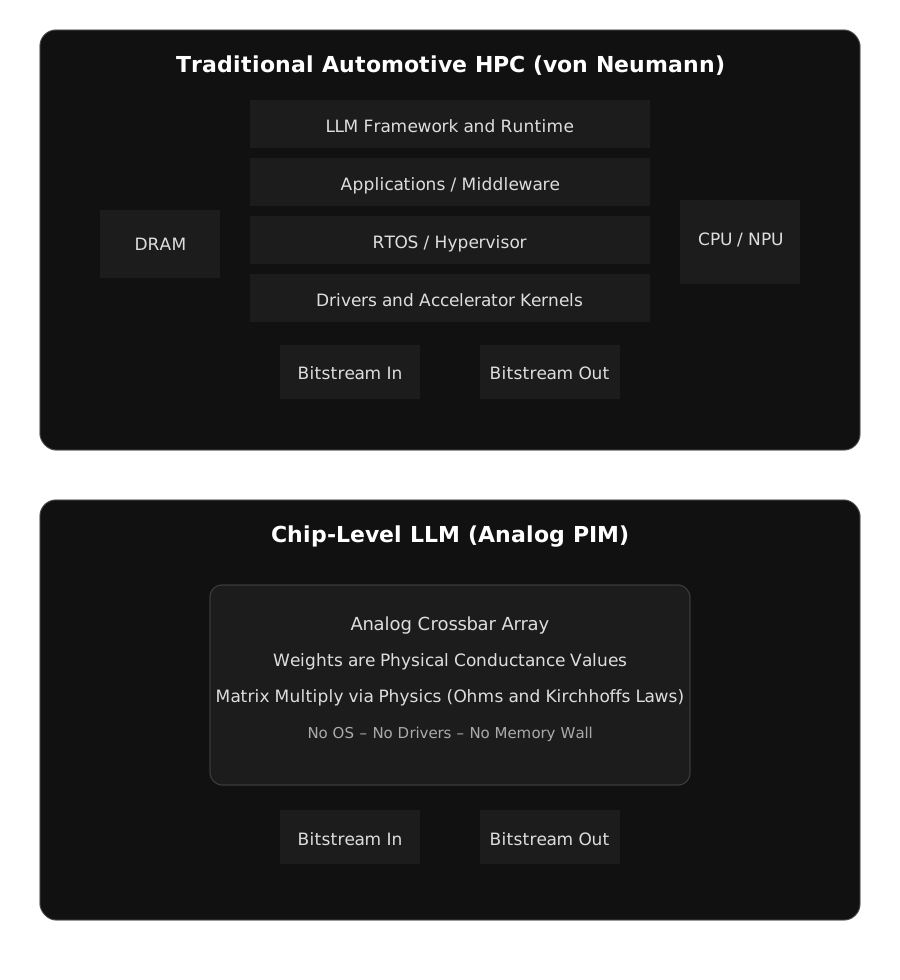
The Future of Automotive HPC: Chip-Level LLMs
- The model becomes the hardware: LLM weights encoded as physical conductances in silicon.
- Physics replaces software: Matrix operations executed via Ohm’s and Kirchhoff’s laws in analog PIM.
- Automotive entry point: Voice, language, and contextual AI — not safety-critical ADAS.
- Process advantage: FD-SOI (22FDX / 12FDX) outperforms sub-3nm FinFET for analog weight stability.
- Cost & area impact: 1 to 2 orders of magnitude reduction in silicon area.
- Strategic shift: Automotive HPC becomes a silicon architecture challenge, not a software scaling problem.
The automotive industry is on the verge of its biggest computing paradigm shift since multicore processors. Traditional Software-Defined Vehicles (SDVs) rely on complex software stacks running on digital von Neumann architectures. The next era belongs to chip-level Large Language Models (LLMs).
What Are Chip-Level LLMs?
Chip-level LLMs, also known as analog or neuromorphic Processing-in-Memory (PIM) systems, eliminate the classic separation between memory and compute. Model weights are programmed directly as physical conductance values in crossbar arrays. Inference becomes a deterministic physics-based operation — no OS, no drivers, no memory wall.
First Automotive Applications: Voice & Language AI
- Speech-to-Text (STT)
- Text-to-Speech (TTS)
- Real-time Multilingual Translation
- Contextual Voice Assistants with long-term memory
Initial deployments will most likely take the form of hybrid SoCs, combining conventional ARM or RISC-V digital cores with dedicated analog chip-level LLM accelerators. These hybrid solutions allow carmakers to leverage existing software stacks and toolchains while gaining the efficiency benefits of analog inference for language workloads.
Only in a later phase — once the technology has proven itself in the field — will we see fully integrated, standalone chip-level LLM devices that operate without a traditional host processor for these non-safety-critical functions.
These workloads only require AEC-Q100 Grade 1 or Grade 2 qualification and bypass the heavy certification burden of safety-critical ADAS systems.

Why Sub-3nm Nodes Are Not Ideal for Chip-Level LLMs
Advanced FinFET and GAA nodes excel at digital logic density but suffer from high device variability, leakage, and poor analog precision — exactly what destroys inference accuracy in analog weight storage.
Recommended Process Technologies for Analog LLM Inference
Fully Depleted Silicon-on-Insulator (FD-SOI) is the superior platform for stable analog computation.
- GlobalFoundries 22FDX & 12FDX — best-in-class device matching, adaptive body biasing, and long-term stability.
- Samsung 28FDS & 18FDS+ — mature mixed-signal integration with excellent analog characteristics.
While TSMC and Intel dominate bleeding-edge digital nodes, their technologies are suboptimal for the core analog crossbar arrays where physical weight fidelity is paramount.
Cost Advantages: Dramatically Lower Silicon Area
One of the strongest economic drivers for chip-level LLMs is the massive reduction in required silicon area compared to conventional digital von Neumann architectures.
By encoding model weights directly as physical conductances in dense analog crossbar arrays, these systems eliminate the need for large SRAM caches, thousands of digital MAC units, and complex data movement circuitry. This results in a reduction of silicon area by one to two orders of magnitude (10× to 100×) for equivalent real-time inference performance in voice and language workloads.
The resulting benefits are significant:
- Substantially lower die cost and higher wafer yields
- Reduced packaging complexity and bill-of-materials (BOM)
- Easier integration into power- and thermally-constrained automotive ECUs
- Overall transformation of automotive AI economics — from software scaling challenges to silicon optimization opportunities
“Chip-level LLMs flip the economics of automotive AI — moving from expensive software scaling to highly optimized silicon area.”
Ready to Architect the Next Generation of SDVs?
Let viable.works help you define your chip-level AI silicon strategy and capture the cost advantages of analog inference.
Start a Conversation →