Digital Native Automotive Development: End PowerPoint Bureaucracy
In the fast-evolving automotive industry, development organizations are increasingly bogged down by an unlikely culprit: PowerPoint. What was once a tool for concise communication has morphed into a time-consuming obligation. Engineers, hired for their technical expertise in designing innovative vehicles, systems, and components, now spend disproportionate hours crafting slides to justify their work, explain progress, and anticipate questions from managers. This misalignment of skills and tasks leads to frustration, reduced productivity, and ultimately, talent attrition.
Engineers didn’t sign up to be presentation specialists—they joined to solve complex engineering challenges.
The root issue is a legacy management paradigm ill-suited to the digital age. Traditional automotive development relies on periodic status meetings, manual report compilation, and ad-hoc investigations to track progress. These practices not only divert engineering resources but also create opacity in project timelines and deliverables. Talented professionals, accustomed to agile, tool-driven workflows from their education and early careers, grow disillusioned when their core competencies are underutilized.
To break this cycle, the industry needs a fundamental shift: the establishment of a digital native automotive development organization. This model reorients the entire workflow around digital tools, traceability, and automation, allowing engineers to reclaim their time for what they do best—design and development—while eliminating bureaucratic overhead.
Core Goals of a Digital Native Organization
At its heart, a digital native automotive development organization prioritizes engineering focus and operational efficiency. The primary objectives are straightforward yet transformative:
- Engineers focus on design and development, using PowerPoint only for the presentation and discussion of solutional artifacts (e.g., features, systems, or components). Slides become outputs of completed work, not daily distractions.
- All transactional work is structured in ticket management systems, such as Azure DevOps or JIRA. These platforms serve as the single source of truth for tasks, deadlines, and responsibilities.
To enable seamless integration, solutional artifacts must either be created directly within the ticket management tool (for native linking) or structured in a compatible format that allows easy cross-referencing. This foundational step unlocks the full potential of digital traceability.
Building Traceability: Horizontal and Vertical Links
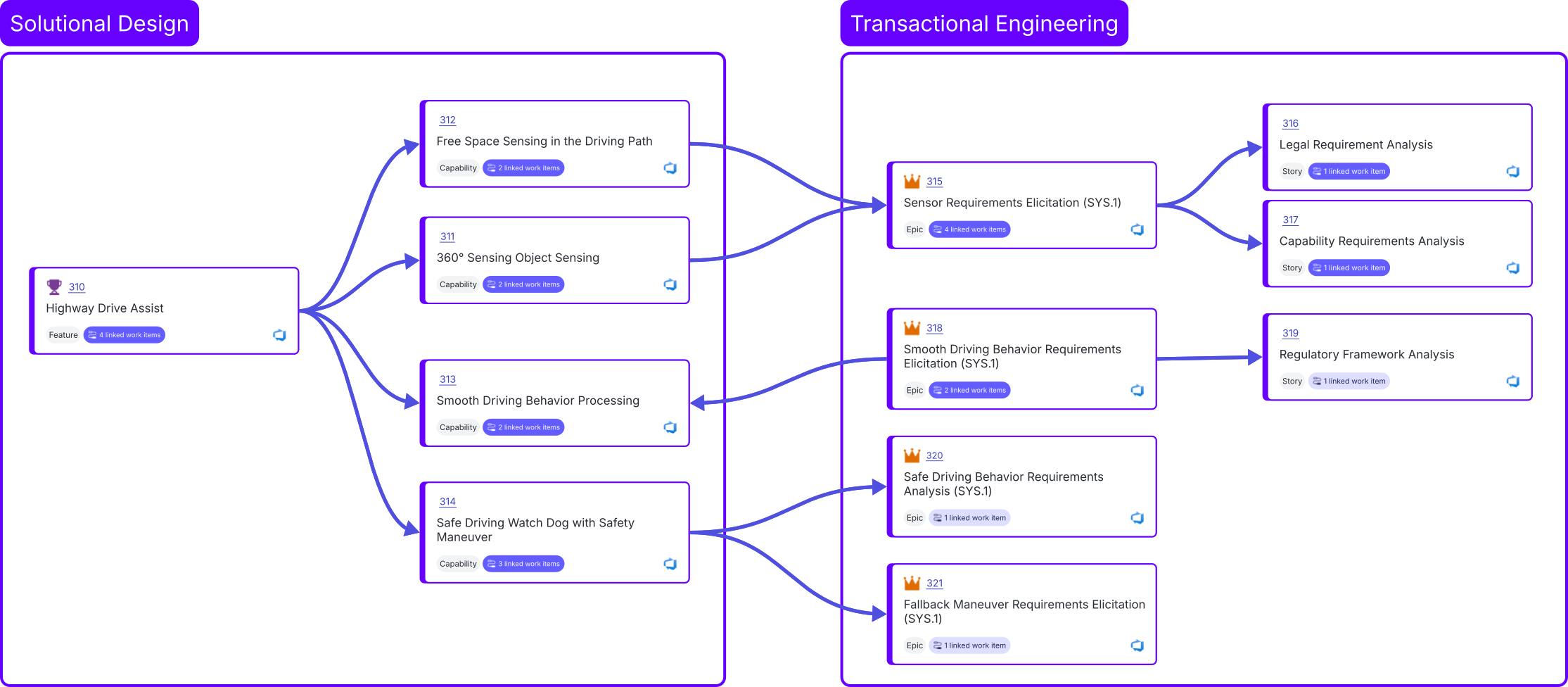
Live Traceability in Azure DevOps: Highway Drive Assist links to SYS.1 epics via horizontal & vertical work item relationships—real-time, audit-ready, executable.
The magic of this approach lies in its structured linking mechanism, creating a transactional twin to the solutional space.
- Horizontal Traceability: Every transactional ticket is directly linked to its corresponding solutional artifact. For instance, a ticket for implementing a new brake system feature links to the brake system’s design specification.
- Vertical Breakdown: High-level tickets (epics) are decomposed into manageable sub-tickets (user stories, then tasks). Each sub-ticket inherits the horizontal links from its parent.
- Counterpart Linking: Sub-tickets can also establish horizontal links to related artifacts at their level—connecting a task to a requirement, a component to a system, or a feature to a regulatory standard.
This web of connections forms a dynamic, bidirectional map between the transactional time domain (what’s being done and when) and the solutional space domain (the evolving design of the product). Changes in one domain instantly reflect in the other, providing real-time visibility without manual intervention.
Management in the Digital Native Era
With this structure in place, traditional management drudgery vanishes:
- Management is based solely on tickets, their statuses, and automatically generated reports. Dashboards pull live data on completion rates, bottlenecks, and dependencies—no more hunting through email threads or outdated slides.
- No PowerPoint status updates, no manual investigations, no “fuck-up” meetings to reconcile conflicting information or decide next steps. The system surfaces issues proactively.
The result? Engineers dive deep into meaningful work—simulating aerodynamic performance, optimizing battery management algorithms, or validating safety systems. Management overhead plummets, with most routine oversight handled by automation.
The New Role of Engineering Management
Freed from micromanagement, engineering leadership evolves into a strategic function:
- Product Management: Defining product vision, prioritizing features, and ensuring market alignment.
- Long-term planning: Roadmapping future platforms, allocating resources across vehicle programs, and aligning with corporate OKRs.
- Problem solving: Stepping in only for complex technical blockers, cross-functional conflicts, or risk mitigation that automated systems can’t resolve.
- Risk Management: Identifying, assessing, and mitigating technical and compliance risks across the development lifecycle.
- Configuration Management: Maintaining integrity of artifacts, baselines, and change control in a traceable, digital-native environment.
- Supplier Management: Coordinating requirements, interfaces, and deliverables with external partners and tier suppliers.
This elevated role attracts and retains high-caliber leaders who thrive on vision and impact, not administrative firefighting.
Benefits at a Glance
| Stakeholder | Key Benefits |
|---|---|
| Engineers | 80%+ of time on core development; reduced burnout; clear link between tasks and product impact |
| Managers | Real-time insights; 50–70% less time in status meetings; data-driven decisions |
| Organization | Faster time-to-market; lower turnover; full audit trail for compliance (e.g., ISO 26262, ASPICE) |
| Product Quality | Fewer disconnected handoffs; early detection of requirement gaps; living documentation |
Path to Implementation
Transitioning to a digital native model requires disciplined change management:
- Tool Selection & Integration: Choose a robust ticket system and ensure it supports rich linking (e.g., Azure DevOps work items with wiki/model integration).
- Artifact Standardization: Define templates for features, systems, and components that embed traceability metadata.
- Training & Culture Shift: Coach teams on “ticket-first” thinking; celebrate early wins in reduced meeting time.
- Pilot & Scale: Start with one vehicle subsystem, measure engineer satisfaction and cycle time, then expand.
Conclusion
The automotive industry stands at a crossroads. Clinging to PowerPoint-centric processes risks losing the next generation of engineering talent to sectors that embraced digital agility long ago. By building a digital native development organization—where tickets trace seamlessly to artifacts, automation replaces bureaucracy, and engineers reclaim their craft—companies can unlock unprecedented productivity and innovation.
At viable.works, we’ve seen this model transform development velocity while boosting team morale. The future of automotive engineering isn’t more slides—it’s smarter systems. The time to go digital native is now.
Ready to Build a Digital Native Organization?
Let our experts guide your transition to traceable, automated, engineer-focused development.
Get in Touch