Towards Truly Viable Autonomy
Ten years ago, at CES 2016, my team at IAV unveiled the Connected Highly Automated Driving (CHAD) prototype – a Microsoft-powered vehicle that demonstrated hands-off driving, V2X-based pedestrian detection, traffic-light interaction, and productivity features like voice-assisted emails via Cortana. The vision was clear: a connected ecosystem enabling safer, more comfortable, and truly reliable autonomous mobility.
The original CHAD prototype demonstration at CES 2016
Today, CES 2026 is once again buzzing with autonomous driving announcements. NVIDIA’s Alpamayo reasoning models promise human-like decision-making in complex scenarios. Mercedes will ship the first production vehicle with this technology in Q1 2026. Cockpit computing, edge AI, and software-defined vehicle architectures dominate the show floor. Progress is undeniable – yet the path to truly viable autonomy remains incomplete.
The Core Requirements for Viable Autonomy
From the outset, three fundamental requirements have defined reliable autonomous driving:
- Natural and Human-Like Driving Behaviour
Intuitive, comfortable maneuvers – confident merging, adaptive speeds, smooth responses – that feel predictable and enjoyable for passengers. - Verifiable Absence of Self-Caused Accidents and Strict Adherence to Road Rules
The system must never initiate a hazard through its own actions and must comply with traffic regulations without excessive restrictions that compromise everyday usability. - Full System Integrity Without Functional Safety Violations
Continuous monitoring, fault detection, and graceful degradation to prevent unsafe or undefined states.
Where We Stand Today – The Gordian Knot
After a decade of intense development, we face a persistent dilemma: systems must currently choose between natural, human-like driving behaviour and verifiable absence of self-caused accidents.
Approaches that emphasise natural behaviour (such as Tesla Full Self-Driving or BMW Highway/Personal Pilot) deliver assertive, intuitive driving that users often find enjoyable and efficient. However, ultimate responsibility for accident prevention still lies with the driver, and broad, verifiable guarantees against self-caused incidents across all conditions are not yet provided.
Systems that prioritise verifiable safety and manufacturer liability (such as Mercedes Drive Pilot or the early Honda Legend Level 3) achieve very low incident rates – but only by accepting conservative dynamics and narrow operational domains. The result is restrained, sometimes hesitant behaviour that feels less natural and limits practical usability.
Even leading robotaxi fleets like Waymo, despite excellent safety records in geo-fenced areas, occasionally exhibit overly cautious behaviour – for example, prolonged hesitation during unprotected left turns or failure to interpret courtesy gestures from other drivers. This can lead to minor traffic disruptions and highlights that purely onboard systems still struggle with the full spectrum of social traffic interaction.
The third requirement – system integrity – has seen the greatest progress. Redundant hardware, sophisticated monitoring, and over-the-air updates are now well established under ISO 26262 practices.
The Solution: Cutting the Gordian Knot
The key to resolving this decade-old conflict lies in three foundational enablers:
- Functionally safe by-wire chassis
Fully redundant, fail-operational steering, braking, and propulsion that can independently execute minimal-risk manoeuvres. This eliminates the need to rely on overly cautious driving styles as the primary safety fallback. - Functionally safe infrastructure at neuralgic points
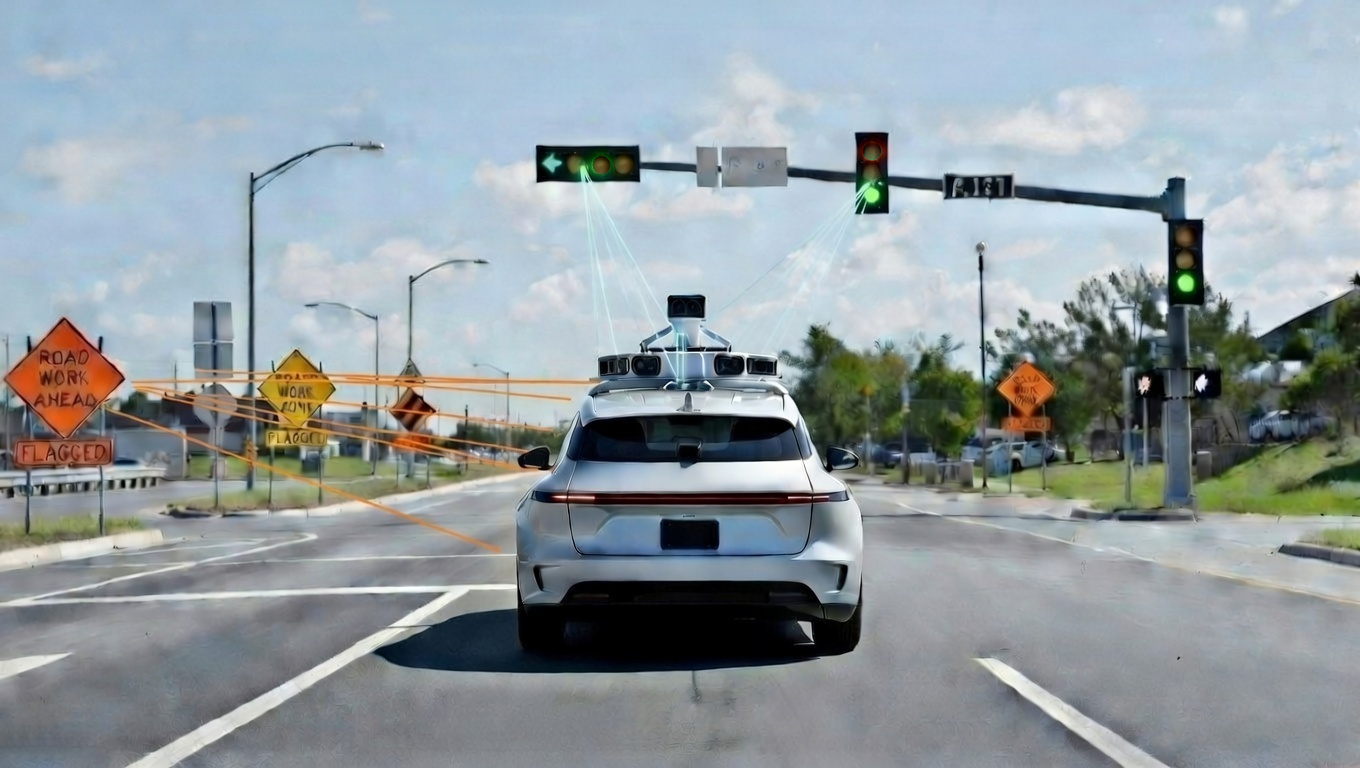
Targeted V2X deployment delivering unambiguous, trustworthy data exactly where onboard perception struggles most – complex intersections, traffic-light arrow states, hidden vulnerable road users, or precise lane topology.
This infrastructure is not required for basic standalone safety (the vehicle must remain safe without it), but it is the decisive factor for enabling truly human-like driving behaviour while preserving verifiable safety guarantees. By removing perception uncertainties at critical points, the system can drive confidently and naturally without defaulting to conservative restrictions. Europe’s existing operational ITS-G5 installations – millions of VW Car2X-equipped vehicles and Autobahn roadworks warnings – already demonstrate that reliable infrastructure augmentation works in series production. - Reliable connectivity and short remote operations
Low-latency, secure connectivity enabling brief, targeted remote intervention when needed. Examples include clearing the path for emergency vehicles, resolving temporary deadlocks between multiple autonomous vehicles at intersections, or handling rare social situations that onboard AI cannot fully interpret.
For robotaxis, this provides an efficient safety and efficiency net. For private vehicles, it offers an optional service layer: the occupant can remain productively engaged (e.g., office work) while a remote operator monitors the journey and intervenes only occasionally – preserving the productivity promise of autonomy without forcing constant driver attention.
Outlook
We stand closer than ever to viable autonomy. Advanced reasoning AI is maturing, by-wire chassis platforms are entering production, functional safety expertise is strong, and connectivity infrastructure is expanding. Combining these three enablers – redundant chassis, targeted infrastructure augmentation, and selective remote support – finally cuts the Gordian knot between natural behaviour and comprehensive safety.
At viable.works, we support clients in designing precisely these integrated architectures that transform today’s constrained capabilities into tomorrow’s everyday autonomous mobility.
What steps are you taking this year to make your autonomous projects truly viable?
Let’s discuss how these enablers can be integrated into your roadmap.
Get in Touch